
The traditional SEO funnel is breaking down. Approximately 60% of all searches in 2024 ended with no clicks, and up to 84% of B2B buyers now use AI for vendor discovery. Rankings still matter, but they no longer guarantee traffic or conversions. The modern SEO funnel strategy requires a fundamental change: from optimizing for clicks to optimizing for citations in AI-generated answers. We'll walk you through how the SEO marketing funnel has evolved, why the dark SEO funnel matters, and what metrics prove success in this new world.
What is the SEO funnel (and why the old model is broken)
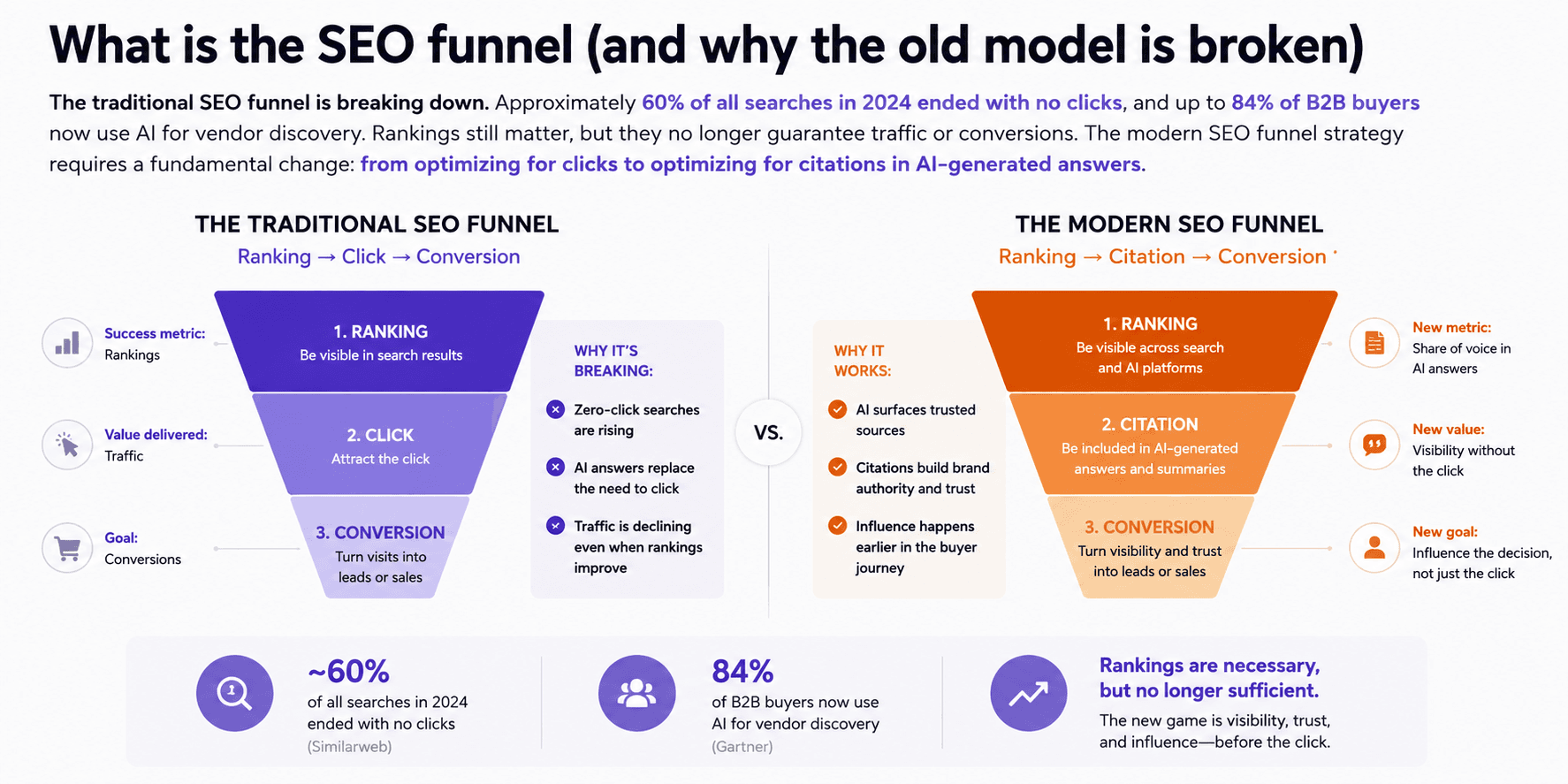
The traditional SEO funnel: rankings, clicks, conversions
The SEO funnel followed a linear progression for years: search engines crawl your pages, render the content, add it to their index, rank it for relevant queries, users click through, and conversions follow. This model assumed that each stage fed into the next. Rankings were the primary success metric because they served as a reliable proxy for traffic potential.
The traditional framework positioned SERPs as launchpads. Users would see your result, review the title and description, then click through to consume your content on your website. Success was measured in sessions, pageviews, and goal completions tracked in analytics platforms. SEO teams focused on moving pages up the rankings to drive revenue and assumed that position one would deliver the highest click-through rates and the most conversions.
This typical SEO marketing funnel worked because Google functioned as a directory rather than a destination. The search engine's role was to point users toward information, not to provide it.
Why rankings no longer guarantee traffic
Position one no longer promises traffic the way it once did. Research shows that AI Overviews now reduce the click-through rate for top-ranking pages by 58%. Organic CTR drops from 1.76% to 0.61% when these AI-generated summaries appear, while paid CTR crashes from 19.7% to 6.34%. Even without AI Overviews present, organic CTR has fallen 41%.
The decline became severe throughout 2025. One website saw impressions more than double after AI Overviews launched in May 2024, while click-through rate fell from about 1.5% to under 0.5%. Position one CTR for informational keywords dropped from 0.076 in December 2023 to 0.039 by December 2025. The decline was steeper for queries triggering AI Overviews: from 0.073 to 0.016 over the same period.
Multiple independent studies confirm the pattern. Seer Interactive found CTR reductions between 49.4% and 65.2%, while other research documented declines ranging from 47.5% to over 50%. The Daily Mail reported traffic losses between 80% and 90% on certain content categories.
This creates a fundamental disconnect in the SEO conversion funnel. Pages can rank well and still hemorrhage traffic if featured snippets answer queries, local packs satisfy intent with calls and directions, or AI Overviews provide blended answers without requiring a click. The old model of "rank well and wait for the traffic" no longer holds.
The rise of zero-click search and AI answers
Zero-click searches occur when users find their answer on the SERP without clicking through to any website. As of 2024, 58.5% of U.S. searches and 59.7% of E.U. searches ended without a click. Research from Bain found that about 80% of consumers now rely on zero-click results in at least 40% of their searches, reducing organic web traffic by an estimated 15% to 25%.
The acceleration followed AI's integration into search. Zero-click percentage grew from 56% to 69% between May 2024 and May 2025. AI Overviews were triggered for 13.14% of queries in March 2025, up from 6.49% in January 2025. In spite of that, the trend existed before AI summaries, driven by feature-rich SERPs designed to complete user journeys without external clicks.
Search engines now answer queries through multiple SERP features:
- AI Overviews that blend information from multiple sources
- Featured snippets providing immediate factual answers
- Knowledge panels displaying entity information
- People Also Ask boxes with expandable answers
- Local packs with business details and contact options
- Video carousels with embedded clips
- Product listings with prices and reviews
These elements transform SERPs from directories into destinations. Users get complete answers at a glance and see that their informational needs are met without leaving Google's ecosystem. The search journey now ends where it begins.
The strategic implications become clear. Traditional analytics miss the full picture when impressions and SERP presence drive brand awareness, consideration, and assisted conversions that never register as sessions. The SEO sales funnel must account for influence that happens inside the SERP itself, where your content serves as source material for AI platforms rather than as a click destination. This doesn't diminish SEO's value but changes how we measure and optimize for success.
How AI search engines are reshaping the funnel
Google AI Overviews and featured snippets
AI Overviews mark a leap forward from featured snippets. Featured snippets extract verbatim content from a single website to answer specific queries. AI Overviews blend information from multiple sources into cohesive, conversational answers. Google's custom Gemini model powers these summaries and uses multi-step reasoning capabilities to handle complex questions.
The rollout accelerated through 2025. Hundreds of millions of users gained access, with Google projecting over a billion users by year-end. AI Overviews now appear in over 11% of search queries. This represents a 22% year-over-year increase. The number of longer, complex queries triggering these summaries grew by 49%.
So Google claims that AI Overviews drive higher-quality clicks. Links included in AI Overviews receive more clicks than if the page appeared as a traditional web listing for that query. Users visit a greater diversity of websites for help with complex questions. Research from one analytics platform suggests that visitors arriving via AI referrals convert 23 times better than traditional organic traffic.
ChatGPT Search, Perplexity, and Gemini as discovery tools
ChatGPT Search blends natural language interface with real-time web information. The search model is a fine-tuned version of GPT-4o, post-trained using synthetic data generation techniques. Users ask questions in natural language. ChatGPT responds with information from the web and includes links to sources like news articles and blog posts. OpenAI partnered with news and data providers to add current information for categories like weather, stocks, sports, news, and maps.
Perplexity processes 780 million queries monthly as of May 2025 and experiences over 20% month-over-month growth. The platform uses large language models and incorporates real-time search capabilities through its Sonar engine, based on Meta's Llama model. Perplexity provides responses with real-time citations. This distinguishes it from traditional search engines by delivering complete answers backed by verifiable sources.
Gemini's grounding with Google Search connects the model to real-time web content. The system analyzes prompts and determines if a Google Search can improve the answer. The model generates search queries, processes results, blends information, and creates responses when needed. The API returns groundingMetadata with search queries, web results, and structured citation data. This workflow enables applications to increase factual accuracy, access current information, and provide citations that build user trust.
The new buyer journey: AI first, Google second
Half of consumers polled in a McKinsey survey now seek out AI-powered search engines. A majority says it's the top digital source they use to make buying decisions. About 50% of Google searches already have AI summaries, expected to rise to over 75% by 2028. More than 70% of AI-powered search users ask questions at the top of the funnel to learn about categories, brands, products, or services.
The implications hit hardest in B2B contexts. AI-first search moves the earliest, most influential part of the buyer's journey off websites and into answer engines like ChatGPT, Perplexity, Gemini, and Google AI Overviews. Buyers build shortlists before vendors know they exist, based on answers AI tools blend from across the web. Your brand must be referenced in those AI-generated answers. Otherwise, you've lost the buyer before they even knew they were evaluating you.
Traditional brand strength provides no guarantee of visibility. SEO focuses on owned-site content, but brand sites comprise only 5% to 10% of sources that AI search references. AI-powered search pulls from arrays of all types, including affiliates and user-generated content. Already, 44% of AI-powered search users say it's their primary and preferred source of insight. This tops traditional search at 31%, retailer or brand websites at 9%, and review sites at 6%.
The modern SEO funnel: ranking → citation → conversion
The SEO funnel now operates through three distinct stages: ranking, citation, and conversion. Each stage builds on the previous one, but success at one level no longer guarantees advancement to the next. This represents a structural departure from the linear progression that defined SEO strategy for two decades.
Stage 1: Ranking (being discoverable in search)
Ranking remains the foundation. Pages must still be crawled, indexed, and positioned within search results to enter the funnel at all. Without ranking, content doesn't exist to AI systems scanning the web for authoritative sources.
The mechanics here haven't changed at their core. Technical SEO factors like site architecture and crawlability still determine whether pages enter search engine databases. Authority signals from backlinks and content quality continue influencing where pages rank within result sets.
What changed is what ranking achieves. Traditional SEO marketing funnel models saw ranking deliver traffic. Now, ranking delivers eligibility for citation. Your position determines whether AI systems think about your content when generating answers, but it doesn't guarantee they'll reference it.
Stage 2: Citation (appearing in AI-generated answers)
Citations represent the critical bottleneck in the modern SEO conversion funnel. When an LLM generates a response, it cites only 2 to 7 sources. Compare that to the 10 organic results on a traditional SERP, and the competition intensifies.
More importantly, 95% of all AI citations come from third-party websites rather than brand-owned properties. AI answer engines blend information from independent sources covering your brand or topic. Your own site content rarely gets cited, even when it ranks well.
This creates what researchers call the "visibility gap." Your content could be powering an AI answer that reaches thousands of users, or your competitor could be capturing that citation slot instead. Without dedicated tracking, you wouldn't know which scenario applies.
Citation tracking differs from rank tracking at a fundamental level. Rank tracking monitors position in a list of results. Citation tracking measures whether AI systems treat your content as authoritative enough to quote or recommend in blended answers. The difference matters because citation frequency influences downstream conversions.
Stage 3: Conversion (turning visibility into action)
Citations drive conversions at rates that dwarf traditional organic traffic. Multiple independent studies document this pattern. Semrush found that users arriving via AI answers convert 4.4 times better than those from traditional organic search. Amsive reported that 56% of sites saw higher conversions from AI-driven sessions, with high-traffic sites converting at 7.05% compared to 5.81% for organic. Similarweb documented AI referrals converting at 11.4% versus 5.3% for organic across global ecommerce.
Microsoft Clarity's analysis of 1,200 publisher and news sites confirmed that AI-driven referrals grew 155% over eight months and converted at up to three times the rate of traditional channels. AI referrals represent under 1% of total visits, yet these users display higher intent and participation.
The explanation lies in qualification. AI-assisted customer journeys are 33% shorter on average than traditional search, and high intent conversion rates are 76% higher for AI-powered experiences. Users who guide through AI answers have already filtered through preliminary information and arrive with clearer purchase intent.
Why citations matter more than click-through rates
Traditional analytics capture clicks but miss the full attribution picture. When structured content appears in AI summaries or comparisons, it shapes brand awareness before users ever visit your site. These pre-click engagements influence trust and downstream conversions, yet they don't register as sessions in Google Analytics.
Citation frequency measures how often your content is cited across AI responses for tracked prompts. High mentions with low citations mean your brand has recognition but your content isn't structured or authoritative enough for AI engines to treat as a primary source. This diagnostic insight proves impossible to extract from click-through rate data alone.
AI Share of Voice compares your citation count against competitors for the same prompt set. This metric reveals where you're winning, where you're losing, and who's taking your place in AI-generated recommendations.
What determines AI citation selection
AI systems filter billions of web pages through selection criteria that grow more sophisticated when deciding which sources deserve citation. You can transform citation optimization from guesswork into strategic execution once you understand these factors.
Content authority and expertise signals
E-E-A-T operates as a binary inclusion filter rather than a marginal ranking improvement. Research shows that 96% of AI Overview citations come from sources with strong E-E-A-T signals. This creates a winner-take-most dynamic where the top 50 brands by authority capture 28.90% of all AI citations.
Author attribution matters. Content with proper metadata and author information gets cited 40% more than anonymous content. The mechanism is straightforward: AI systems triangulate information to verify credibility before citing. Named authors with verifiable credentials, publication history and consistent cross-web identity provide the computational verification these systems require.
Bylines should link to author pages that display credentials, expertise areas and professional affiliations. "Written by Sarah M., Registered Dietitian" or "Reviewed by Dr. Patel, MD, Updated May 2025" communicates both human expertise and recency signals.
Original research and first-party data
Content featuring original data shows a 40% higher citability rate compared to generic content. This advantage stems from becoming the primary entity for that information. AI models cite you as the source rather than secondary interpretations when you publish proprietary studies, customer insights or industry standards.
First-party data from platforms like Google Search Console are the foundations of original analysis. You generate unique insights that AI systems value when you track which keywords drive impressions, identify pages gaining traffic and document CTR changes across devices.
Brand mentions and entity recognition on the web
Press mentions in authoritative outlets build entity recognition through co-occurrence, named-entity extraction and inbound authority. AI systems learn category associations and relationships when credible sources mention an entity with related topics and attributes.
Quality dominates volume. A single mention in a top-tier outlet contributes more to entity recognition than dozens in low-authority sources because systems weight source credibility. Research confirms ChatGPT cites Wikipedia (47.9%), Reddit (11.3%) and Forbes (6.8%), while Google AI Overviews pulls from Reddit (21%), YouTube (18.8%) and Quora (14.3%).
The strategy centers on consensus building. AI models cite you with confidence if your website claims X and five external sources confirm X. Models default to external validation or skip citing you if claims conflict with external consensus.
Publisher reputation and domain trust
Domain reputation captures behavioral history, technical signals and usage patterns. Google evaluates trustworthiness through E-E-A-T alignment, content originality, topic consistency and security infrastructure.
Technical trust signals include HTTPS implementation, spam filtering history and security certificates. These factors influence ranking trust, indexing decisions and whether AI systems think a domain reliable enough to cite.
Content structure: headers, lists and clear answers
Structured data formats receive 3x more citations than paragraph-only content. Headers create logical hierarchy that AI systems use to understand passage context, with 44.2% of all LLM citations coming from the first 30% of text.
Bullet points and numbered lists see 67% more frequent extraction. Well-laid-out headings help AI systems identify topic scope, with question-based H2 and H3 headings targeting search queries. The optimal passage length for AI extraction falls between 150-300 words per section.
Semantic relevance and topical depth
Topical depth refers to thoroughness and information richness both within individual content pieces and topic clusters. AI models review semantic depth by scanning content structure, relationships between articles and coverage completeness.
Sites using topical clusters see 3.2 times more keyword rankings per page. Domains with high topical authority retain rankings 45% longer during core updates. This happens because semantic relevance signals genuine expertise rather than keyword manipulation and lines up with how modern AI systems interpret meaning and user intent.
The dark SEO funnel: measuring invisible attribution
SEO has moved from rank, click, and convert to get scraped, summarized, and recommended. We've entered the era of invisible attribution where traditional top-of-funnel traffic collapses, the messy middle gets messier, and SEO success can no longer be measured by clicks alone.
What is the dark SEO funnel
The dark SEO funnel represents the algorithmic search equivalent of dark social. A peer recommends a brand in private channels like Slack or WhatsApp where tracking pixels can't see them in dark social, and the buyer then searches on Google. Similarly, an LLM recommends the brand in dark SEO, and the buyer searches for it later to verify the choice.
The process unfolds in three invisible stages. An LLM consumes your content and understands your entity first. A user asks a problem-aware question such as "best tools for X" second, and the LLM recommends your brand as a solution. The user goes to Google third and searches for your brand name to verify the choice. Analytics platforms attribute the credit to "direct" or "branded search." SEO or GEO did the actual work that drove that discovery meanwhile.
Discovery happens in a non-click environment, attribution gets wiped out, and SEO appears to underperform even while it fills the pipeline actively.
How AI recommendations drive branded search
Up to 84% of B2B buyers now use AI to discover vendors, and 68% start their search in AI tools before they ever touch Google. Buyers use ChatGPT to narrow down options and Google to verify. One surveyed CMO explained the change: "I use Google only if I have certainty about which specific software types or products I want".
AI serves evaluation purposes. Google serves verification purposes. This represents a radical departure from traditional search behavior.
You need to understand two types of visibility to win in this environment. Brand mentions occur when an LLM names your company as a solution to category queries. You can't technical SEO your way into these recommendations. Entity strength drives them, specifically how often your brand appears with relevant topics on review sites, communities like Reddit and Quora, and third-party publishers.
URL citations happen when AI tools link to your content as a source because you provided unique data or represented the most relevant result. AI cites you to ground its answer when you publish proprietary information, contrarian views, and first-party research[302].
Why traditional analytics miss the full picture
Leadership still demands proof that SEO works even though traffic no longer serves as the north star KPI. Your attribution model breaks if brand discovery happens in AI but last-click conversion happens on Google.
Traditional web analytics attribute subsequent branded search traffic as "direct" or "organic branded" rather than linking it to the original AI-driven discovery. This obscures SEO's true effect and misleads marketers about performance, especially in B2B contexts where research phases stretch across weeks or months.
The strongest teams pivot to defensible signals that track revenue and reputation rather than clicks. Branded traffic serves as a proxy for dark funnel success since non-branded visibility in AI answers guides brand searches in this era[302]. Website leads cite "ChatGPT" or "Perplexity" on intake forms that ask how they heard about you, and that signals what one expert calls the Great Normalization of SEO: trading high-volume noise for high-intent signal.
Generative Engine Optimization (GEO): the new SEO discipline
Generative Engine Optimization emerged as a distinct discipline to address the structural gap between traditional SEO and AI-intervened discovery. The term appeared in 2024 as AI systems integrated into mainstream search. The practice now covers everything from content structure to external brand signals across the web.
What is GEO and how it is different from traditional SEO
GEO optimizes for presence in AI-generated answers from ChatGPT, Perplexity, Google AI Overviews and similar tools. The core difference centers on output. SEO positions pages in ranked lists. GEO ensures brands get cited, mentioned or recommended inside combined answers.
Search engines rank pages. LLMs combine assertions. Someone asks which vendors offer a specific solution. The model draws on probability distributions shaped by training data and retrieval-augmented configurations rather than retrieving ranked URLs. What counts as credible in that context gets influenced heavily by breadth and consistency of claims across trusted sources.
SEO drives clicks while GEO earns citations. Traditional SEO gets content listed. GEO gets content recommended. Success metrics change so from rankings and traffic to citation frequency, brand mentions in AI answers and share of voice in AI tools.
Building content for AI comprehension
AI systems process information in chunks. They rely on patterns, heading hierarchy and content grouping. Structure determines whether documentation takes full advantage of AI tools. Unstructured documents with multiple topics on one page increase hallucination risk. They produce irrelevant answers.
Headings define topic and set context for AI parsing. Content broken into smaller, semantically meaningful sections allows models to identify relevant text with accuracy. Each component should have standalone purpose even without original document context.
Strategic external brand signals and third-party mentions
Brand mentions on authoritative third-party sites function as core GEO signals. Vendor-owned content carries lower epistemic weight than sourced editorial mentions on sites covering entire categories without commercial stake. The difference mirrors how Wikipedia citations outweigh press releases and operates at the generative retrieval level.
Consistency matters as much as volume. Vendors appear across topically coherent, authoritative sources with consistent terminology and category associations. Models develop confident priors about what that vendor does and where it belongs. Coverage on independent platforms now serves as infrastructure for how models represent brands.
Entity disambiguation and consistent messaging
Entity disambiguation resolves which specific brand, product or person each mention refers to before generating answers. This invisible judgment shapes every AI answer and recommendation users see. Dictionary-word brand names, acronyms or generic product labels create prime conditions for AI confusion.
Consistent brand identity across owned assets amplifies signal strength. Exact brand name documentation including capitalization, spacing and punctuation should remain the same across websites, business profiles, social media and directory listings. Inconsistency confuses entity recognition systems.
New KPIs for the AI-powered SEO funnel
Measuring success in the AI-powered SEO funnel requires abandoning click-centric analytics in favor of signals that track influence, recommendation, and attribution in non-click environments.
Citation frequency and AI visibility tracking
Attribution rate measures how often your brand or site gets cited in AI answers. Tools like Ahrefs now track AI citation counts and show how many times your domain appears as a cited source across major AI platforms. Citation frequency serves as the clearest signal of domain trust in generative AI systems.
Share of AI voice in your category
Share of voice quantifies how often your brand appears within AI-generated results compared to competitors. The average brand mention rate sits at just 17.2%. You can measure visibility growth monthly using tools like LLM Refs to track this. This metric mirrors traditional keyword tracking but applies to AI prompt responses.
Branded search volume growth
Branded traffic functions as a proxy for dark funnel success. Non-branded visibility in AI answers guides users to brand searches, which then guide them to conversions. This becomes a leading indicator when AI recommendations stimulate users to Google for verification.
AI referral traffic and conversion rates
AI referral traffic converts at higher rates than organic search. Traffic from AI citations may be smaller in volume but grows fast. GA4 reports can track AI-related traffic sources, conversions and revenue.
Why traffic alone no longer proves SEO success
Your strategy misaligns with the market if you're reporting CTR while customers get answers from AI systems that never show a link. Traffic metrics miss assisted conversions happening inside AI interfaces before users ever click.
Industries most affected by the citation economy
Citation economy pressures concentrate most intensely in knowledge-intensive industries where decision-makers bypass traditional search to consult AI. The global B2B SaaS market, valued at $497.41 billion in 2025 and projected to reach $4,441.49 billion by 2034 with a 27.54% CAGR, faces particular vulnerability as buyers now use AI to discover vendors before they participate with sales teams. Legal services mirror this pattern. About 41% of law firms and 47% of corporate legal departments already deploy GenAI throughout their organizations.
Healthcare information shows similar exposure. Nearly eight in ten adults search online for health answers, and almost two-thirds encounter AI-generated responses. About 63% of those users find AI health information reliable. This establishes AI as a main health discovery channel despite accuracy concerns from medical professionals.
Financial services firms respond by embedding AI throughout operations. About 78% of financial institutions implement GenAI for at least one use case, and 86% anticipate substantial expansion in their model inventory. Risk management and compliance dominate deployment priorities.
E-commerce companies experience immediate measurement of citation effect through recommendation engines. Beauty retailer Orveon Global reported 10% to 15% average order value lifts across brands after implementing AI-powered merchandising. This shows how product citation within AI interfaces affects purchasing behavior.
Conclusion
The citation economy restructures how we approach SEO strategy. Rankings still open doors, but citations close deals. Then your measurement framework must evolve beyond traffic metrics to track AI visibility and brand mentions across generative platforms.
We recommend auditing your content for AI comprehension. Build external brand signals through third-party mentions and establish citation tracking with traditional rank monitoring. Tools exist today to measure these signals, though the discipline remains young.
Consider conversion data: AI referrals outperform organic traffic by 4x to 23x across industries consistently. That gap will only widen as adoption accelerates. Adapt now, or watch competitors capture citations while you optimize for clicks nobody makes.
Key Takeaways
The SEO landscape has fundamentally shifted from optimizing for clicks to optimizing for citations in AI-generated answers, requiring a complete rethink of strategy and measurement.
• Rankings no longer guarantee traffic: AI Overviews reduce click-through rates by 58% for top-ranking pages, with 60% of searches ending without clicks in 2024.
• The new SEO funnel is ranking → citation → conversion: Success now depends on appearing in AI-generated answers rather than just ranking well in search results.
• AI referrals convert 4-23x better than organic traffic: Users arriving through AI citations show dramatically higher purchase intent and conversion rates across industries.
• 95% of AI citations come from third-party sources: Your own website content rarely gets cited directly; focus on building external brand mentions and authority signals.
• Track citations, not just clicks: Measure AI visibility, share of voice in AI answers, and branded search growth as leading indicators of SEO success.
The citation economy rewards brands that optimize for AI comprehension through structured content, authoritative third-party mentions, and consistent entity signals across the web. Traditional traffic metrics miss the full attribution picture when discovery happens in AI interfaces before users ever visit your site.