The relationship between internal links and SEO has grown way beyond the reach and influence of the simple PageRank model that made Google stand out at the time it launched in 1998. Google now implements about 9 algorithm improvements every week. These changes have transformed how search engines interpret website structures. The data proves the value - 51% of marketers see positive results within just a few months after implementing internal linking strategies.
Most SEO professionals understand internal linking's importance, yet few get into how search engines interpret these connections' context. A well-laid-out internal linking strategy boosts rankings, crawlability, and user engagement. On top of that, it helps search engines review content relevance and topical depth. Search engines use these internal links to guide their web crawlers - automated bots that search and index web pages - through your site's structure. This piece delves into anchor text variation patterns, section-level versus page-level signals, and link placement priority's impact on SEO performance.
How Googlebot Uses Internal Links for Discovery
Links form the foundation of Google's crawling process. The success of your SEO strategy depends on internal linking. You need to understand how Googlebot uses these connections to improve your search rankings.
How Googlebot Uses Internal Links for Discovery
Search engine crawlers don't see websites like we do. They follow paths that links create and build a map of your site's structure and relationships. This affects which pages get attention, how often they're crawled, and where they show up in search results.
Crawl paths created by internal links
Googlebot follows a specific sequence of page visits called a crawl path each time it visits your website. Your internal linking structure determines these paths. Search engines follow the internal links to find more content when they land on any page. This creates a natural way to move through your site.
Your site's internal linking structure shapes its crawl paths. These paths act like highways that direct search engines through your content. Search engines will find and index your important pages faster when you have a clear, logical structure. A messy or deep link structure can leave valuable pages hidden from crawlers and slow down indexation.
The number of clicks needed to reach a page from your homepage shows its crawl depth. Pages closer to the homepage get crawled more often and indexed faster. Google might give lower priority to pages that take more than three clicks to reach. Your high-value content should be within three clicks of your homepage to improve discovery.
Your most important pages need the most internal links. This tells Google which content matters most on your site. The Internal Links report in Google Search Console helps you check your linking structure. Your strategy lines up with best practices if your key content tops this list.
Orphan pages and crawlability issues
Orphan pages can hurt your website's technical SEO performance. These pages have no internal links pointing to them from anywhere on your site. Users and search engines can't find them.
Orphaned pages create several issues:
- Indexation challenges: Google might miss pages without internal links. Even pages in your XML sitemap get lower priority than well-connected content.
- Authority distribution problems: Orphan pages get no PageRank or link equity from other site pages. This cuts their ranking potential.
- User experience issues: People can't find orphaned content through normal navigation. They need direct URLs to access these pages.
- Crawl budget inefficiency: Orphan pages waste crawl resources that should go to your important content.
Disconnected pages weaken your site structure over time. They cut off content from internal links, authority flow, and clear crawl paths. Search engines look at internal signals to judge trust and relevance. These isolated pages hold back performance even when the rest of your site looks good.
Finding orphan pages is tricky because they exist outside your normal site structure. Regular site audits often miss them since crawlers find pages by following links. You need to compare crawl data with XML sitemaps, Google Analytics, and Search Console reports. This helps spot URLs getting traffic or appearing in indexes without internal links.
Role of XML sitemaps vs internal links
XML sitemaps and internal links work together but serve different purposes in Google's discovery process. Both help search engines find your content with varying levels of influence and priority.
Gary Illyes from Google said XML sitemaps are the second most important way Google crawls and finds URLs. Internal links rank first. This shows how Google prioritizes different discovery methods.
XML sitemaps work behind the scenes. They give search engines a structured map of your content with key details like update times. They help search bots find new content, deeply buried pages, and orphaned pages with few internal links.
XML sitemaps alone won't do the job. Google says proper internal linking should make all your content easy to find. Many sites don't link their content logically, creating gaps in discovery paths. That's why Google wants at least one internal link pointing to every important page on your site.
The connection between internal links and sitemaps matters more as websites grow. XML sitemaps help large sites with big archives, new sites lacking external links, and content-heavy platforms with lots of media. They make crawling more efficient and eco-friendly by showing direct paths to important content.
Internal links offer benefits that sitemaps can't match. They spread link equity and help Googlebot assess page authority and relevance. They also provide context about content relationships and topic clusters across your site.
Use both strategies for the best results. Build a solid internal linking structure where important pages get contextual links from related content. Add detailed XML sitemaps that include all valuable URLs. This approach maximizes visibility and clearly shows your site's structure and content priorities.
Understanding Link Equity Beyond PageRank
"I'd forget everything you read about 'link juice.' It's very likely all obsolete, wrong, and/or misleading. Instead, build a website that works well for your users." — John Mueller, Google Senior Search Analyst, SEO and crawling expert
Link equity stands as a foundation of SEO that reaches way beyond the original PageRank algorithm. SEO specialists often focus only on building external backlinks. The way authority flows inside your website matters just as much to boost search visibility.
Understanding Link Equity Beyond PageRank
How authority flows through internal links
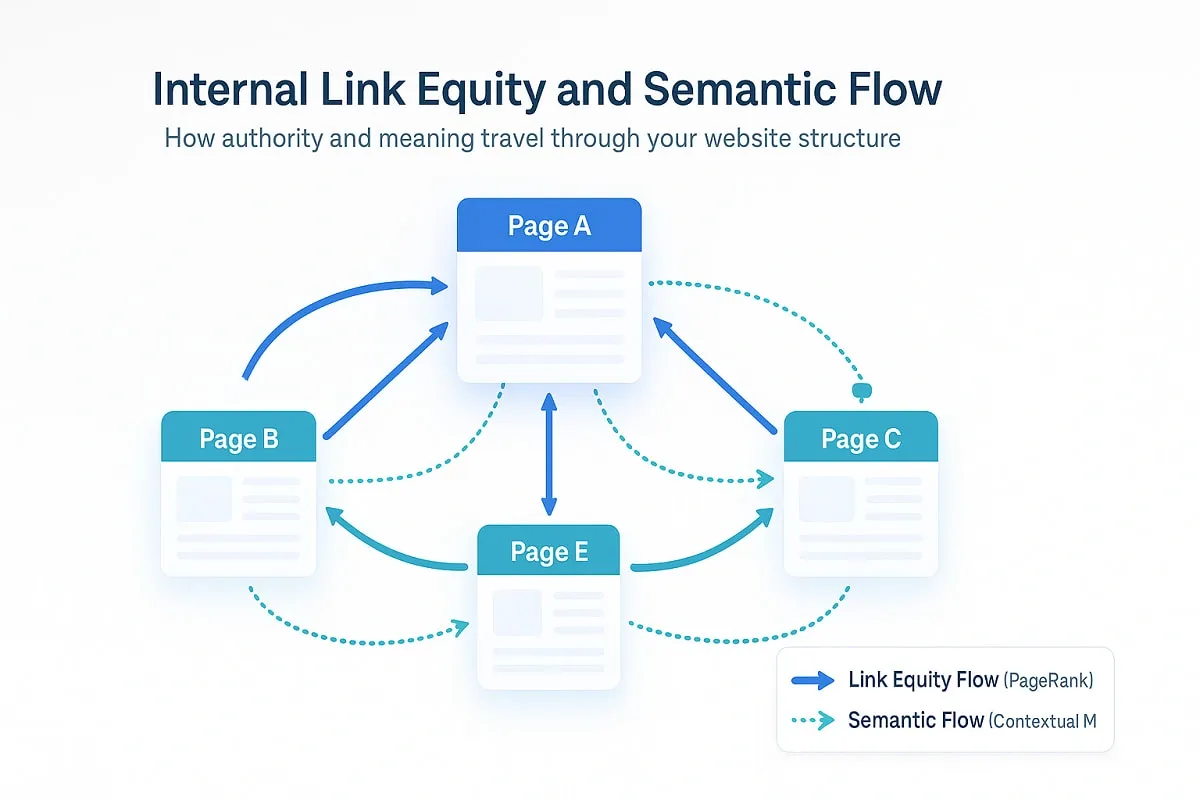
Link equity works like a distribution system that spreads authority across your website. A page passing SEO value to another through links creates a network of value transfer. This network lets you strategically raise important content.
Your homepage usually holds the strongest link value because it naturally gets the most backlinks. This makes it perfect to distribute authority through your site. High-authority pages can share their strength with newer or less visible content where it helps most.
Picture link equity as energy flowing through your website. The amount of "power" that moves through each link depends on several factors:
- Page authority - Links from stronger pages pass more value
- Link relevance - Links between related topics carry greater weight
- Link placement - Links in main content pass more equity than footer or sidebar links
- Anchor text - Clear descriptions provide context and boost equity transfer quality
Your internal linking structure guides this authority flow. A well-laid-out architecture makes sure every key page gets its share of link equity. This helps support product or conversion pages that might not attract external backlinks naturally.
Internal linking does more than help navigation—it distributes authority with purpose. Creating paths from popular content to strategic pages lets equity flow where it helps your site most.
PageRank vs immediate link signals
PageRank revolutionized search when it launched, but Google's link evaluation has grown far beyond this single algorithm. Now PageRank serves as one of many signals that feed into broader ranking systems. Modern systems look at multiple factors at once:
- Content usefulness and depth
- Source credibility and topical authority
- User intent satisfaction
- Spam and manipulation patterns
- Entity relationships and contextual meaning
PageRank helps measure trust and authority but doesn't control rankings by itself. Today's link signals work more dynamically and contextually than the original algorithm suggested.
Clear site architecture and logical internal linking matter more in modern SEO than tweaking link attributes. Rather than worrying about PageRank scores (which Google no longer shows), build meaningful connections between related content.
Nofollow attributes show this progress. Google created them to block equity transfer completely, but now treats nofollow as a "hint" instead of a rule. This change means nofollow links might pass small amounts of equity, especially in editorial content.
Redirects need careful thought too. A 301 redirect keeps most link equity, making it best for permanent URL changes. But redirect chains can weaken equity with each extra step, showing why direct connections work better.
Effect of link freshness and update frequency
Link equity behaves like fresh milk—it loses strength over time. This time factor changes how Google sees connections throughout your site.
Freshness affects link equity in several ways:
- Value distribution - Strong pages linking to many places share only pieces of available equity
- Crawl depth effects - Deeper pages get weaker signals
- Update influence - Regular content updates help maintain stronger equity flow
Your internal link structure should let Google reach any page in few clicks. Shorter paths between authoritative pages and other content boost crawl frequency and spread link equity site-wide.
"Orphan pages" with no internal links show the worst freshness problems. Google can't see these disconnected pages. Without links to your site structure, they get no equity flow, which limits their ranking potential.
Anchor text plays a vital role in equity transfer. Keywords in anchor text signal search engines about the destination page's topic. Using different anchor text prevents over-optimization and builds richer connections between content.
To distribute link equity well, create clear paths from your strongest content to pages needing ranking support. This helps commercial or conversion pages that might find it hard to rank on their own.
Anchor Text Variation and Semantic Relevance
Anchor text is the visible, clickable text in internal links that shows context to users and search engines. These words and phrases act as semantic signals that help Google understand your site's topics and relevance.
Anchor Text Variation and Semantic Relevance
Exact match vs partial match anchors
The way you choose between exact match and partial match anchor text creates big differences in how Google processes internal links. Exact match anchor text uses the precise keyword that matches the destination page. A link to a running shoes page with "best running shoes" as anchor text shows an exact match approach. This method gives maximum keyword clarity but comes with potential risks.
Partial match anchor text includes the target keyword with extra context words. Rather than just "best running shoes," you might see "check out the best running shoes for marathons". This reads more naturally while still showing search engines what the content covers.
The numbers tell us something interesting. Studies of thousands of top-ranked pages show exact match anchors should only be 5-10% of your total anchor text. Partial match anchors work best at 25-35% of your internal link text.
These numbers aren't random. Google's algorithms can spot unnatural patterns in anchor text. The most successful sites use varied anchor text that puts user experience ahead of keyword density.
Google's official guides never mention using "keyword rich" anchor text. This shows a gap between common SEO practices and what Google actually wants. The algorithm now looks at context more than repeated keywords.
Long-tail anchors and user intent
Long-tail anchors are a special type of partial match text. They use four or more words that combine target keywords with descriptive terms. These longer phrases create better context signals that match how people actually search.
Long-tail anchors work well because they match specific user intent. Search engines now focus on understanding what users want, and long-tail anchors give clear signals about page content. To name just one example, instead of "internal linking," you might use "why e-commerce stores should invest in internal linking".
User intent drives SEO success today. People search with specific goals beyond finding keywords. Some intentions are clear, like looking for store hours. Others need more context, such as product maintenance searches that might show research or buying intent.
Long-tail anchors fit this shift toward intent-focused optimization. They give Google extra clues about what problems a page solves. This builds stronger connections between related content.
Most long-tail anchors happen naturally in external links. Writers often use whole subheadings or sentences as anchor text. While you can't control external links, this pattern offers good lessons for internal linking.
Avoiding over-optimization penalties
Over-optimization happens when sites use similar anchor text too much across internal links, especially with exact keyword matches. This looks unnatural to search engines and can trigger filters that spot manipulation attempts.
Signs of over-optimization include:
- Too many exact-match anchor texts
- Same anchor phrases used across the site
- Awkward phrasing that forces keywords
- Anchor text that doesn't fit the content around it
These patterns look suspicious without variation. Google's Penguin update targeted this behavior and penalized sites with unnatural link patterns. The results can hurt - from lower rankings to complete removal from search.
The best approach uses mixed anchor text variations. Research shows you should spread your internal link anchors across these types:
- Exact match: Uses the precise target keyword (5-10% of anchors)
- Partial match: Uses keyword variations with context (25-35%)
- Branded: Uses your brand name with keywords
- Generic: Uses natural phrases describing the destination
Recent data shows anchor text variety matters more than the number of internal links on a page. This backs up the idea that Google's algorithms care more about contextual relevance than link quantity.
The "Think Like A Reader" test helps avoid over-optimization. Before adding an internal link, ask if a visitor would naturally click that anchor text to learn more. If it feels forced or irrelevant to the paragraph, the link won't help users or search engines.
While Google keeps its over-optimization detection private, they confirm that repeated anchor text reduces internal link value. This explains why sites with natural, varied linking do better than those focused on keywords.
The best anchor text strategy focuses on context rather than keyword density. Creating internal links that improve the user's trip with descriptive, varied anchor text that shows what's next keeps both visitors and search algorithms happy while avoiding penalties.
Section-Level vs Page-Level Link Interpretation
"I know some people do SEO experiments and try to figure this out and kind of work out 'Oh Google currently does it like this' but from our point of view can change and it's not something that we have so even if you manage to figure out how we currently do it today then that's not necessarily how we'll do tomorrow or how it's always it's across all websites." — John Mueller, Google Senior Search Analyst, algorithm change warnings
SEO professionals usually focus on link quantity and anchor text. They often miss how link placement affects interpretation. John Mueller of Google states, "We don't really differentiate there. If things are linked in your footer of the page, and they are linked from across the whole website, then from Google's point of view, you have those links from across your whole website". His statement challenges the common belief that footer links don't matter as much as content links.
In stark comparison to this popular belief, Google doesn't reduce link value just because of where they sit in the HTML structure. "It's not the case that Google would say 'Oh, links in the footer have less weight, or they are not as useful, so we will go ahead and ignore them,' or anything like that". Internal links pass similar signals whether they're in headers, footers, or navigation menus.
All the same, context affects how Google sees your content. The search engine treats links and content text in different ways. "It is slightly different when it comes to text in there, though, in that Google does try to understand what the primary content on the page actually is". Google uses the main content section to rank pages while it looks at links everywhere to figure out site structure.
This two-part system creates a unique way Google processes your site. Mueller explains, "When it comes to actually ranking the page, Google will focus primarily on the actual primary content of the page. Links, from Google's perspective, just help them to get a better understanding of the site structure".
Text around your links sends extra context signals beyond anchor text. "Google uses the words surrounding your links as an indication of relevance when it ranks your site". This helps search engines connect topics between pages. You can check this using Ahrefs Backlinks Report with the "Anchor with surrounding text" filter, which shows many relevant mentions beyond exact anchor matches.
User clicks on links seem to affect their value in Google's system. Recent findings suggest "a link's ability to pass ranking value is conditional, not inherent". Google's internal documents show a tiered link index where unclicked links might drop to lower-quality tiers where algorithms ignore them.
Links within relevant content work better than plain navigation links. Natural links in topical discussions help search engines understand page relationships and get more user clicks. This creates better link quality signals over time.
Content silos and topic clusters use this knowledge by building pyramid-like structures. Broad "pillar" pages link to detailed "cluster" pages. This setup improves user navigation and helps search engines understand topic connections better.
Google doesn't care where you place HTML links, but context and user behavior affect their impact by a lot. Your internal linking strategy should focus on making relevant connections within meaningful content instead of worrying too much about exact placement.
Key Takeaways
Google's internal link interpretation has evolved far beyond simple PageRank, incorporating sophisticated signals that evaluate context, user behavior, and semantic relevance to determine page authority and rankings.
• Crawl depth matters more than link quantity - Pages within 3 clicks of your homepage receive priority crawling and faster indexation than deeply buried content.
• Link equity flows through contextual relevance, not just volume - Authority transfers more effectively through topically related connections than through generic site-wide links.
• Diversify anchor text to avoid penalties - Use exact match anchors sparingly (5-10%) while emphasizing partial match (25-35%) and natural variations for optimal performance.
• Link placement context influences user engagement - While Google doesn't devalue footer links algorithmically, contextually relevant in-content links drive better user interaction and ranking signals.
• Orphan pages kill SEO potential - Pages without internal links receive no authority flow and remain invisible to both users and search engines, regardless of XML sitemap inclusion.
The most effective internal linking strategies prioritize user experience and natural content relationships over keyword manipulation, creating clear crawl paths that benefit both search engines and site visitors.
FAQs
Q1. How does Google interpret internal links beyond PageRank? Google now considers multiple factors beyond PageRank, including content relevance, user intent, and contextual signals. Internal links help distribute authority, create crawl paths, and establish topical relationships between pages.
Q2. What role do anchor texts play in internal linking? Anchor texts provide context for both users and search engines. A diverse mix of anchor text types, including exact match (5-10%), partial match (25-35%), branded, and generic, helps avoid over-optimization while conveying relevance.
Q3. How important is link placement on a webpage? While Google doesn't explicitly devalue footer or sidebar links, contextually relevant in-content links often perform better. The surrounding text and user engagement with links influence their effectiveness more than their specific HTML location.
Q4. What is the impact of orphan pages on SEO? Orphan pages (those without internal links pointing to them) receive no authority flow and are essentially invisible to search engines. This severely limits their ranking potential and wastes valuable crawl budget.
Q5. How does crawl depth affect page performance? Pages within three clicks of the homepage typically receive priority crawling and faster indexation. Deeper pages may be crawled less frequently and considered less important, highlighting the need for a clear, logical site structure.