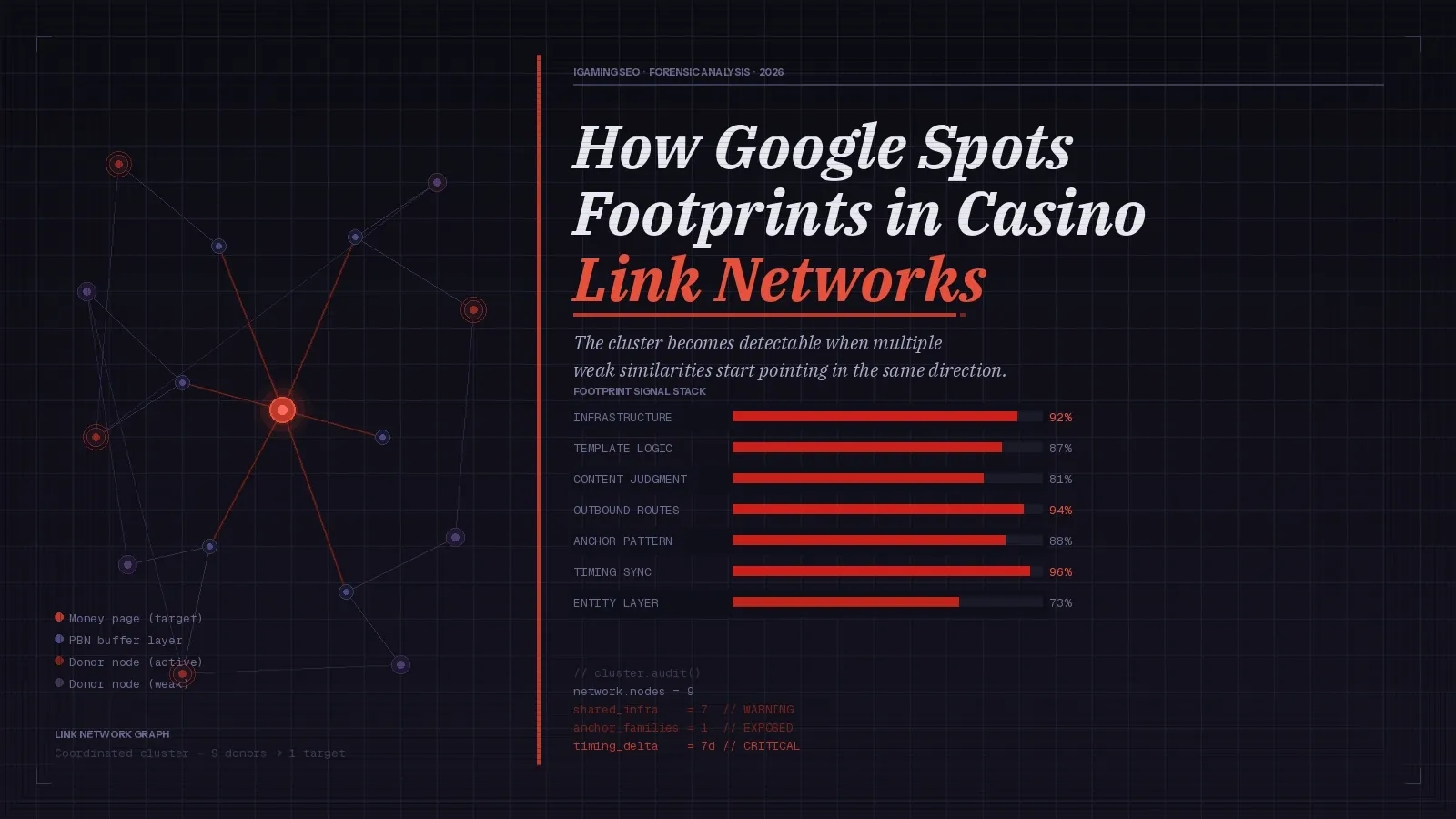
Most gambling link networks do not fail because Google suddenly "found the PBN." They fail because the network kept repeating itself across hosting, templates, authorship, anchor deployment, and outbound behavior - until the cluster became easier to read as one machine than as a group of independent sites. The skins change. The pattern stays the same.
Why iGaming Link Networks Are Easier to Map Than Most Owners Think
The biggest mistake in network management is checking whether each site looks different on its own. That is the wrong test. The real test is whether the cluster survives comparison when its relationships, timing, publishing habits, outbound routes, and commercial behavior are viewed together.
Google does not need certainty to act. It needs enough confidence that a group of sites is not independently operated. In gambling SERPs, one of the most heavily monetized, heavily manipulated verticals in search, that threshold is lower than most operators assume. The niche is crowded and full of manufactured editorial sites pretending to be independent voices. Weak signals do not stay weak for long once they start stacking.
Real sites drift. They publish unevenly. They make inconsistent editorial choices. Their layouts evolve at different speeds. Their authors do not all sound like the same person. Their outbound links are not perfectly aligned to the same commercial targets.
Network sites do the opposite. They repeat operational habits because the same team builds them, fills them, updates them, and monetizes them with the same systems. The same person picks domains. The same designer builds review layouts. The same content team uses the same scoring logic. The same link manager pushes the same landing pages when rankings slip. The same freshness pass runs across multiple sites inside the same week.
The most dangerous footprints are not technical in the old-school sense. They are behavioral. A network becomes detectable when multiple weak similarities start pointing in the same direction.
No single fingerprint usually triggers action. The problem is accumulation. Infrastructure overlap stacks with template reuse. Template reuse stacks with content habits. Content habits stack with outbound concentration. Outbound concentration stacks with synchronized timing. At some point the cluster stops looking like coincidence and starts looking coordinated.
Infrastructure Footprints: The Obvious Layer That Still Burns Lazy Networks
Most SEOs know the obvious warnings. Same IP. Same WHOIS. Same cheap hosting provider. Those signals still matter, but they are no longer the whole game. The operators who get caught now are not usually the ones who forgot WHOIS privacy. They fixed the easy clues and kept the deeper setup logic identical.
The real infrastructure problem is repeated technical behavior across domains that have no believable reason to look related. Different IPs do not help much if too many nodes still sit inside the same wider infrastructure pattern. Signals that stack into a detectable cluster:
- ASN concentration - shared hosting providers across too many nodes, visible even when IPs differ
- Same CDN or security stack - Cloudflare plan tier, firewall behavior, SSL certificate issuer habits repeated across properties
- Same registrar behavior across domain batches - registration timing, WHOIS patterns, privacy service choice
- Synchronized DNS shifts - multiple domains updated in the same window, suggesting coordinated batch management
- Identical CMS and plugin fingerprints - same WordPress version, same active and inactive plugin traces, same hardening choices
- Image hosting reuse - same external CDN, same compression artifacts, same upload naming conventions
- Uniform crawl response behavior - same redirect logic, same robots.txt patterns, same 404 handling, same cache headers
- Batch rollout behavior - themes, SSL, and DNS updates pushed in tight windows across supposedly unrelated domains
A common mistake is partial diversification. The owner spreads domains across multiple servers, then keeps the rest of the stack identical. Same WordPress hardening choices. Same image optimizer. Same review plugin. Same comparison table shortcode logic. Same affiliate button generator. The owner thinks the footprint is hidden because the IPs differ. It has just moved up one layer.
Case 01 - Infrastructure cluster exposure:
A network of nine casino review sites used different domains and visual branding. Seven sat behind the same hosting pattern, the same caching stack, the same image compression trail, and a near-identical plugin fingerprint. None of those signals proved control alone. Together they stripped away the independence story. Rankings held for almost a year. Then support pages across five of those domains lost visibility inside the same two-week window.
Template Footprints: Where Fake Diversity Starts Cracking
Most network owners think changing colors, fonts, and logos is enough differentiation. It is not. Structural sameness survives visual reskinning. Google does not need your sites to look identical. It only needs to see repeated layout logic across properties that claim to be independent.
The template footprint lives at the layout logic level, not the design level. It shows up in the same places again and again:
- Identical money page sequences - offer summary, rating widget, pros/cons, payment icons, CTA, FAQ, final verdict - always in the same order
- Repeated review table design - same column structure, same scoring criteria, same field order
- Same CTA block position - same viewport zone, same spacing logic, same urgency language
- Identical bonus box structure - same fields, same visual hierarchy, same T&C placement
- Same comparison page skeleton - different operators listed, identical structural frame underneath
- Repeated "licensed by / payment methods / withdrawal time" sequence at the same depth on every review page
- Same responsible gaming strip position and wording across brands
- Same compact operator summary paragraph length and sentence structure
This is especially common on casino review pages and "best casino" list pages. Once a layout converts, operators keep cloning it. That makes business sense. It also creates a structural fingerprint across the entire network.
Case 02 - Template overlap across branded sites:
Three independently branded sportsbook sites used different homepages, different color schemes, and different author names. But every review page repeated the same structure: offer summary, rating widget, pros and cons, payment icons, CTA, FAQ, final verdict. The spacing rhythm matched. The conversion block matched. The commercial sequence matched. The page-level fingerprint was stronger than the branding differences. 60 percent of commercial review pages shared the same structural logic.
Content Footprints: Repeated Judgment, Not Copied Text
When people talk about content footprints, they usually think about duplicate paragraphs. That is not where most gambling networks get caught. The deeper issue is repeated editorial judgment. Different sites can use original text and still expose common ownership because they evaluate operators using the same priorities, the same paragraph order, the same scoring logic, and the same tone of commercial evaluation.
They shared judgment, not text. Every review scored operators on the same six categories, used the same sentence cadence in the verdict, and repeated the same language around bonus fairness and withdrawal speed. Human readers would not notice. Pattern comparison would.
Content production tells that accumulate into exposure:
- Same scoring categories across every site - bonus value, game selection, payment speed, support quality, mobile experience, withdrawal time - in the same evaluation order
- Repeated title formulas - "Best [Vertical] Sites in [GEO] [Year]" across multiple domains with identical structure
- Same heading rhythm - same depth, same keyword density behavior, same subheading placement throughout
- Identical semantic padding around money terms - same context sentences surrounding primary keywords
- Recurring phrase habits - same transitional language, same safety disclaimers, same offer description wording
- Fake author personas written in the same voice - different names, identical analytical style and sentence construction
- Freshness theater - several domains that barely changed for months suddenly get new "last updated" stamps, refreshed intros, and revised bonus wording in the same window. That is not editorial drift. That is coordinated maintenance.
Case 03 - Shared judgment across separate brands:
A cluster of casino sites shared no copied paragraphs. On the surface the content looked unique. But every review scored operators across the same six factors, used the same sentence rhythm in the verdict, and repeated near-identical phrasing around bonus fairness and withdrawal speed. Pattern comparison would catch what a manual content audit would miss.
Outbound Link Patterns: The Thing Most Operators Underestimate
Most SEOs spend their risk management energy on the inbound profile. Outbound behavior is one of the strongest footprint layers in any support-site network and is badly underestimated. Google does not only assess who links to you. It evaluates how your linking behavior makes your site look, and what that behavior says about who controls it.
A site says a lot about itself through what it links to, how often, where those links sit, and how concentrated those destinations are. Outbound signals that expose coordinated control:
- Repeated commercial destinations across network nodes - multiple "independent" sites linking to the same small set of money pages
- Unnatural target concentration - a review ecosystem where 80 percent of outbound money links resolve to three operators
- Similar anchor logic across different domains - same commercial phrase families, same variation patterns, same specificity level
- Repeated link placement zones - money links appearing in the same paragraph position, same content zone, same proximity to headings
- Links only on pages with matching commercial intent - no natural outbound on informational pages, purely commercial behavior
- Stale editorial sections with fresh outbound money links - aged filler pages suddenly receiving one fresh commercial insertion in paragraph three or four, using a partial-match anchor tied to the same landing page group
- Editorial emptiness outside money behavior - a site that rarely links to regulators, payment providers, game studios, or anything outside its affiliate agenda
This is where many casino networks destroy the work they did to diversify infrastructure and styling. The sites may look broad on the surface, but the value routing is too neat. The same operator pages keep receiving links. The same paragraph positions hold those links. The disguise breaks.
Case 04 - Outbound clustering on a support-site network:
A support-site group looked broad from a distance. Multiple niches, multiple content types, no obvious domain overlap. But nearly every commercial link pointed into the same small set of casino and sportsbook assets, using the same anchor families, from the same paragraph zones, inside pages with nearly identical monetization intent. The sites were different at surface level. The outbound pattern was one commercial agenda wearing multiple masks.
Anchor Deployment: How Target Pages Expose Coordinated Control
A network often looks natural at the donor level and artificial at the target-page level. That is the most overlooked footprint problem in gambling SEO. Operators review donor metrics, feel safe because the domains look varied enough, and miss what the receiving page is actually collecting.
If several unrelated-looking domains all send closely related anchor families to the same landing page in the same velocity window, that page starts carrying a pattern that only coordinated control can explain. Anchor percentages are not enough as a diagnostic tool - sequence matters, timing matters, placement logic matters. Whether anchors come from review pages, list pages, filler articles, or old content matters.
Anchor-level signals that reveal network coordination:
- Synchronized anchor ramps - exact and partial matches introduced in the same velocity window across unrelated donors
- Anchor family reuse - the same commercial phrase variants appearing across domains with no organic variation
- Brand-plus-money-term stacking - systematic combination of brand mentions with commercial modifiers across the cluster
- Same landing page attracting the same anchor logic from domains that share layout, content, or timing overlap
- Thin support pages used only to deploy money anchors - informational wrappers around pure commercial placement
- Velocity spikes that align with rank-tracking reactions rather than editorial publishing schedules
Case 05 - Target page anchor signature:
A sportsbook landing page picked up 14 new referring pages in six weeks. On paper the donors looked unrelated. In practice the anchors clustered around the same commercial phrase family, the links sat in similar content sections, and the ramp lined up with a ranking push after a core update window. The footprint was not really on the donors. It was forming around the receiving page.
Timing Footprints: The Silent Killer Most Networks Never Audit or Think About
Timing is the footprint that most operators never think to check, and it is one of the clearest signals of coordinated control. Independent sites do not usually wake up, publish, refresh, and place links in coordinated rhythm. Networks do - especially when rankings drop and the owner starts pushing every available asset at once.
Timing signals that expose network management:
- Synchronized site launches - multiple domains going live in the same week with no editorial reason
- Same publishing windows - all network nodes producing content in the same repeating time bracket every month
- Outbound links inserted in waves - commercial links added across multiple sites inside the same 48-hour period
- Dormant sites reactivated together - previously thin or inactive domains all publishing within the same update window
- Synchronized freshness theater - sites that barely changed for months suddenly get "updated" edits, revised intros, refreshed bonus copy, and new outbound placements in the same two-week window
- Decay patterns mirrored across the cluster - ranking losses and gains echoing across domains that should have no relationship
- Link bursts tied to rank-tracking reactions - velocity spikes that correlate with ranking drops rather than real editorial opportunity
One of the loudest signals is coordinated freshness. Owners think they are maintaining relevance. From a cluster perspective, they are exposing management.
Case 06 - Dormant reactivation pattern:
Five review sites had been mostly inactive for months. Two weeks after rankings dipped for a main casino page, all five pushed fresh "best of" pages, inserted commercial links, and refreshed author timestamps inside the same seven-day window. No shared server was needed to expose the pattern. Their reaction timing did the work.
Entity and Identity Footprints: Where Operators Get Lazy
The entity layer feels cosmetic to many network owners. It is not cosmetic. It is another place where the same team repeats itself, and that repetition leaves a trail.
- Recycled author personas with slightly edited bios - same bio structure, same credential claims, same writing voice under different names
- The same editorial team concept appearing across multiple branded properties
- Stock-photo expert faces with no real trail - no social presence, no bylines outside the network
- Cloned social shells - accounts created on the same platforms, same posting cadence, no real audience
- Identical about page logic dressed in different copy - same company story structure, same regulatory language, same "why we exist" framework
- Repeated trust badge zones - same licensing logos in the same page positions, same disclaimer language
- No believable reason for the site to exist beyond commercial outbound activity
A believable site has some unevenness to it. The tone is not perfectly cloned. The trust pages fit the brand. The team identity is not generic. Many gambling support sites are built to pass a quick trust check, not to survive cross-site comparison. They have author boxes, policy text, and review criteria - but none of it feels native. Once that same trust costume repeats across a cluster, the costume becomes part of the fingerprint.
What Serious Operators Do Differently
This is not a guide to building a safer PBN. It is a description of how operators who think in long-term risk terms approach network architecture differently from those who think in short-term disguise.
The first shift is straightforward. Stop asking whether each site looks clean on its own. Start asking whether the cluster survives pattern analysis when viewed as a relationship graph.
Principles that distinguish durable campaigns from fragile ones:
- Think in cluster diversity, not single-site disguise - audit the network as a system, not a list of individual domains
- Reduce operational repetition - if the same person, tool, or process builds every site, the fingerprint is consistent regardless of surface differences
- Separate publishing logic where editorial independence is being claimed - sites asserting independence cannot share publishing infrastructure
- Avoid templated commercial behavior - if every site monetizes using the same conversion logic, the commercial agenda becomes a pattern
- Build sites with a reason to exist beyond linking - topical authority, genuine audience, or real informational value creates plausible independence
- Watch the anchor signature forming around target pages, not only the donor mix - the money page's incoming pattern is often more diagnostic than individual donor profiles
- Audit networks as relationship graphs, not domain lists - map the connections, the timing, the outbound, and the behavioral similarities as a full system
In long-horizon iGaming SEO campaigns, this kind of structural thinking has to be part of execution from the start. It cannot be patched in later by swapping themes or moving hosting after the network is already repeating itself in public. The real mistake is building a network for control instead of building an ecosystem that can survive comparison.
The Pattern That Appears Right Before a Network Gets Burned
There is a recognizable late-stage behavior in networks that are about to lose trust. Rankings stall. Pressure builds. The natural reaction is escalation - and that escalation is usually what makes a previously stable cluster suddenly visible:
- More exact-match anchors pushed to the same money page
- Faster publishing across support sites to increase link velocity
- Harder commercial placement - links moved higher on the page, thinner content around them
- Broader reuse of the same support properties that worked before
- Reduced differentiation effort - less patience for structural separation because the pressure to rank outweighs it
- Dormant sites pulled back into service because they are available, not because they are ready
From the operator's point of view, this looks logical. From a pattern point of view, it compresses the network. More links from the same cluster, faster, to the same targets, with the same anchors, in the same windows, from the same kinds of pages. The construction did not necessarily change. The behavior under pressure did.
A network that stayed stable for eight months started leaking obvious cluster signals once its owners tried to push the same money page from too many support domains in the same quarter. The individual sites had not suddenly become bad. The network had become too eager, too synchronized, and too repetitive.
How Footprints Actually Accumulate
Casino PBN footprints and gambling link network footprints are rarely about one catastrophic mistake. They are accumulated repetitions that individually mean little and collectively mean everything.
The operator who checks whether each site looks different in isolation is solving the wrong problem. Search systems compare clusters. They compare timing. They compare structural behavior. They compare commercial coordination. They compare how supposed editorial properties move when a money page needs support.
That is why the common beginner mindset fails in iGaming. Hosting takes ten minutes to change. Logos take an hour. Themes can be swapped in a day. None of that matters much if the whole ecosystem still behaves like one controlled system when rankings are under pressure.
The difference between networks that hold and networks that collapse is often not one brilliant technical trick. It is whether the operator ever stopped thinking in isolated sites and started auditing the cluster as a relationship graph.
Key principle: Google does not need proof of control. It needs enough repeated similarity to justify treating the cluster as one machine. Once that threshold is crossed, it does not matter how different the logos are.
Frequently Asked Questions
What is a footprint in casino SEO?
A footprint is a repeated pattern across infrastructure, content, timing, authorship, or linking behavior that makes supposedly independent sites look operationally related. It becomes a problem when enough weak signals accumulate in the same direction - not because one signal is fatal, but because the stack becomes hard to explain away as coincidence.
Can visually different sites still belong to the same detectable network?
Yes - and this is the most common misconception in network management. Visual variation only changes the surface. Sites can use completely different branding and still expose common control through layout logic, outbound behavior, anchor deployment, timing, and repeated editorial judgment. The disguise is skin-deep. The pattern runs underneath.
Why does timing matter so much in gambling link networks?
Because independent sites do not usually update, publish, and place links in coordinated waves. When several domains react together inside the same window - refreshing content, inserting anchors, reactivating dormant pages - the behavior itself becomes the footprint, even when the technical signals look clean.
Are hosting footprints still relevant in 2026?
Yes, but mostly as part of a larger pattern. Shared infrastructure alone is rarely enough to trigger action. Shared infrastructure combined with repeated layout logic, outbound concentration, timing overlap, and anchor coordination is where the risk compounds. Fixing only the hosting layer while leaving everything else identical is partial diversification - it moves the footprint, it does not remove it.
What usually exposes a casino support-site network?
Not one fatal clue. Usually it is a cluster of repeated signals: similar site structure, similar review logic, concentrated outbound targets, matching anchor families, and synchronized updates when rankings need help. The exposure often accelerates when the operator panics and escalates - pushing harder from the same sources, faster, with the same anchors, making the coordination impossible to ignore.